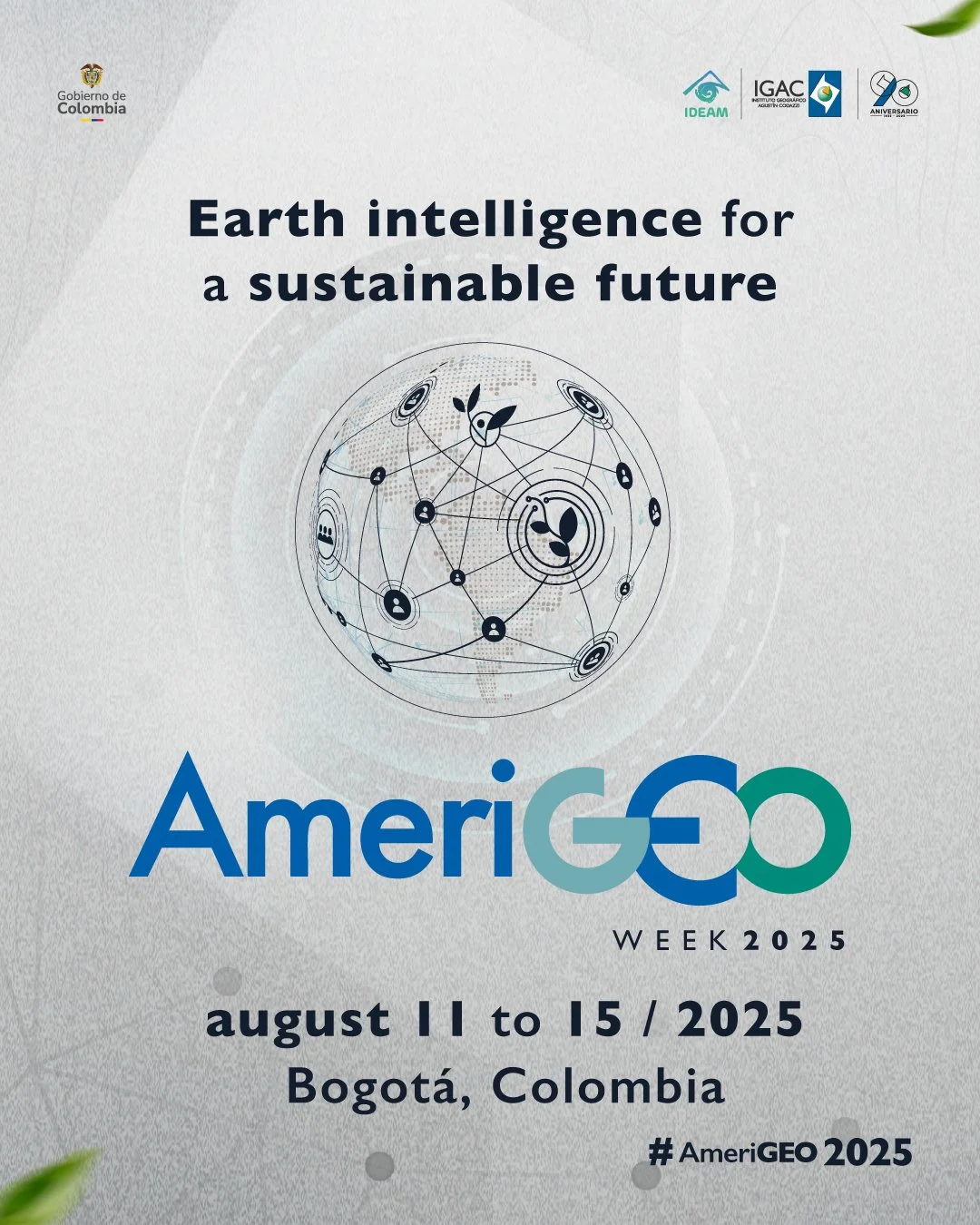
The AmeriGEO Week 2025, using the theme Earth Intelligence for a Sustainable Future, will be held from August 11-15, 2025 at the National University of Colombia (UNAL), with support by Colombia’s Institute of Hydrology, Meteorology and Environmental Studies (IDEAM) and Agustín Codazzi Geographic Institute (IGAC).
YouTube Recordings for AmeriGEO Sessions:
Pre-AmeriGEO Event: Overview of the NASA PACE Mission and a Cloud-based Toolkit for Analyzing Data: Spanish LINK
Day 1 – Monday, August 11: Spanish LINK / English LINK
Day 2 – Tuesday, August 12: Spanish LINK / English LINK
Day 3 – Wednesday, August 13: Spanish LINK / English LINK
Day 4 – Thursday, August 14: Spanish LINK / English LINK
How Satellite-Based Systems Can Drive Methane Mitigation Workshop: Spanish LINK
Day 5 – Friday, August 15: Spanish LINK
Biogeography of One Health Diseases (SANO) Workshop: English LINK
Scientific Session: Promoting Earth Science Applications for One Health Partnerships
Date/Time: August 13 from 10:45AM-12:00PM COL/GMT-5)
Description: As global health systems prepare for emerging hazards – whether air pollution, extreme heat, or infectious disease outbreaks – robust partnerships across the Earth and Health sciences are fundamental to integrate data sources, quantify exposure or disease risk, and support public health surveillance and preparedness. Using the One Health concept, this session aims to examine local needs, leverage expertise to integrate satellite- and ground-based data with public health surveillance data, and offer actionable information to mitigate the risk of harmful environmental exposures. Supported by the GEO Health Community of Practice, Inter-American Institute for Global Change Research, Humboldt Institute, the Colombia Ministry of Health and Social Protection, and the Colombia Ministry of Environment and Sustainable Development, this session will highlight specific health priorities in the Americas region and demonstrate how Earth science applications can strengthen public health surveillance and foster robust One Health partnerships. Panelists will describe the need for innovative approaches to enhance data integration and interoperability, which can encourage youth and student engagement and broaden scientific regional networks across the Earth and Health science communities. Panelists will share best practices on how national collaborations have fostered multidisciplinary collaborations in the environmental sciences and supported co-designed solutions with community stakeholders.
Scientific Session: Marine Biodiversity and Blue One Health in the Americas: Advancing Health Resilience through Ecosystem Sustainability and Earth Intelligence
Date/Time: August 13 from 3:15-4:30PM COL/GMT-5)
Description: Spanning the Pacific Ocean and the Caribbean Sea, Colombia’s extensive coastline hosts a diverse and productive marine ecosystem that underpins coastal livelihoods, food security, and ecosystem services for the Americas. Colombia’s vast marine protected areas support crucial ecosystems such as kelp forests, mangroves, and coral reefs, as well as provide economic benefits through the Blue Economy, fisheries, tourism, and various other industries dependent on aquatic ecosystem health. From marine heat waves and emerging zoonotic diseases to pollution and overfishing, these threats have compounding and cascading impacts across human, animal, environmental, and ecosystem health. Supported by the GEO Health Community of Practice, GEO Blue Planet Initiative, Group on Earth Observations Biodiversity Observation Network (GEO BON), US Marine Biodiversity Observation Network (MBON), and the Institute of Marine Affairs, this session will showcase how Blue One Health, an emerging and interdisciplinary framework highlighting marine and aquatic ecosystems in the One Health approach, and Earth Observations (EO) data can highlight critical solutions to monitor and predict aquatic ecosystem health risks while promoting ecosystem sustainability through interdisciplinary collaboration and incorporating biodiversity applications in policy and decision-making across the Americas.