
Five work groups, facilitated by the GEO Health Community of Practice (CoP), will support the implementation and sustainability of the Earth Observations for Health (EO4HEALTH) framework and respective activities. Contributing members and participating organizations of these work groups can provide scientific and technical expertise on selected health-related topics for specific project tasks, projects, and activities. They will continue to identify and engage health partners, clarify and address health needs for capacity building, and identify and address Earth observation (EO) and prediction gaps and needs. Cross-cutting themes related to One Health and the integrative information systems will be relevant for relevant issues that connect the objectives of each Work Group. To join a Work Group, please contact Helena Chapman.
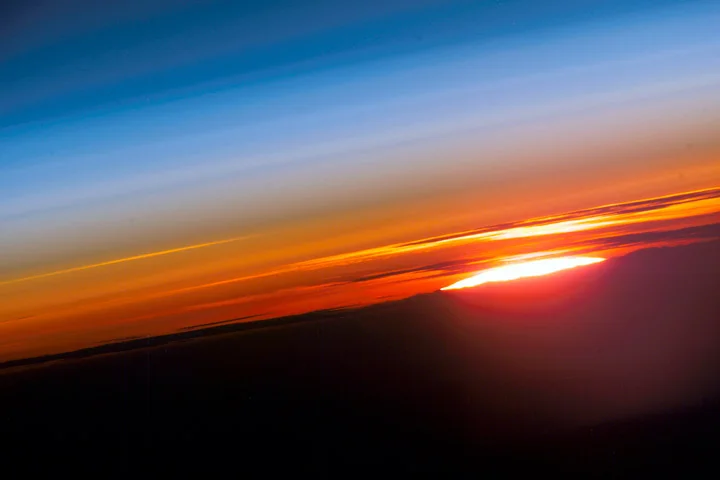
Energy from the Sun heats the surface, warms the atmosphere, and powers the ocean currents. Credit: NASA Earth Observatory (Astronaut photograph, courtesy NASA/JSC Gateway to Astronaut Photography of Earth)
Work Group 1
Prediction and Prevention of Heat-related Health Risks across Time Scales
Work Group 1 aims to build a global mapping capability that conveys heat risk and identifies the most critical used or needed heat, forecast, land cover, and social vulnerability data.
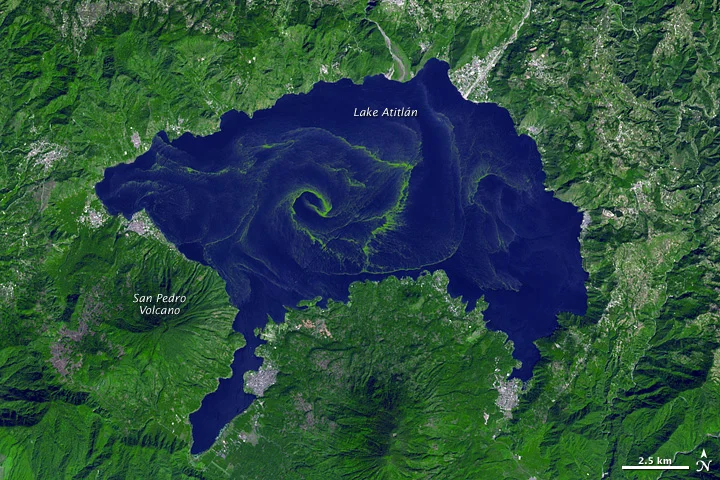
A large bloom of cyanobacteria spread across Guatemala’s Lake Atitlán. Credit: NASA Earth Observatory
Work Group 2
Prediction and Prevention of Environmentally-sensitive Infectious Diseases
Work Group 2 seeks to improve prediction and prevention systems for environmentally-sensitive infectious diseases (e.g. vector-borne and water-related diseases) that enhance decision-relevant risk monitoring to mitigate human health risks in vulnerable communities.

Rare wildfires in western Greenland. Credit: NASA Earth Observatory
Work Group 3
Air Quality, Wildfires, Respiratory Health
Work Group 3 intends to develop a modeling framework that enables the development of space-time specific assessments, monitoring, and forecasts to quantify the levels of exposure of populations to wildfire-related pollutants and aeroallergens.
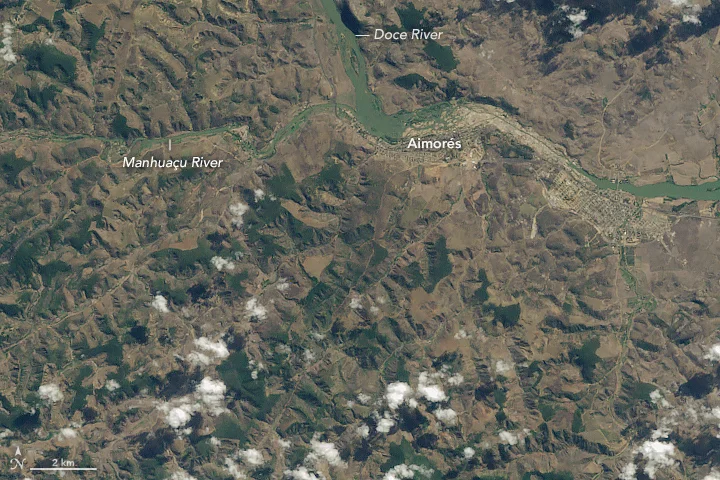
A twenty-year effort to plant millions of trees in Minas Gerais, Brazil. Credit: NASA Earth Observatory
Work Group 4
Food Security and Safety
Work Group 4 aims to strengthen applications that address food- and water-borne diseases that undermine health, food safety, and monitoring and prediction of pathogens and toxins, including marine and coastal environments.
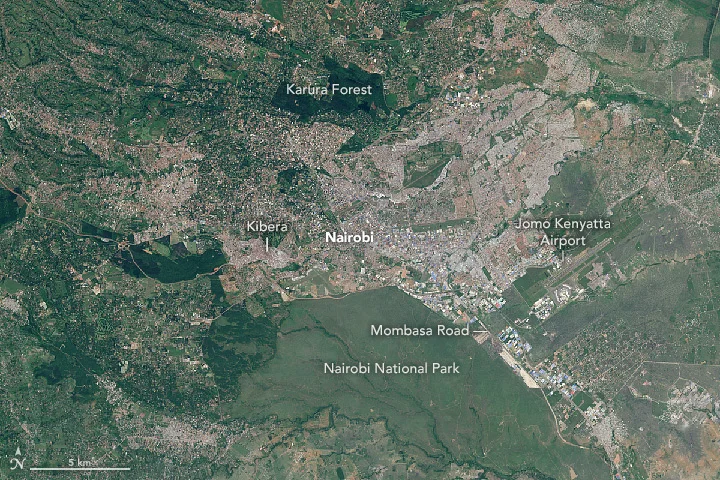
Nairobi is a prime example of urban migration, with its population pushing upward and its boundaries pushing outward. Credit: NASA Earth Observatory
Work Group 5
Health Care Infrastructure
Work Group 5 seeks to develop an informational resource with Earth observation data that can help decision-makers assess the vulnerability and adequacy of health care infrastructures to local environmental stressors and regional extreme catastrophes.
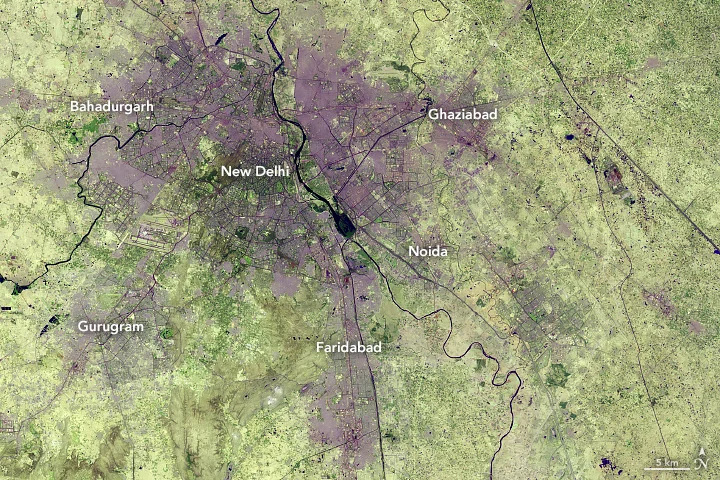
Croplands and grasslands around New Delhi are being converted into city structures to create one of the fastest urban expansions in the world. Credit: NASA Earth Observatory
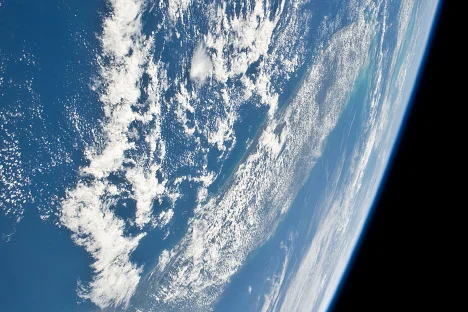
Clouds can both cool the planet (by reflecting visible light from the sun) and warm the planet (by absorbing heat radiation emitted by the surface). Credit: NASA Earth Observatory (NASA Astronaut Photograph STS31-E-9552, courtesy Johnson Space Center Earth Observations Lab.)
Cross-Cutting Issues
Other One Health cross-cutting issues can explore the integration of Earth observation data with other data sources to prevent and respond to health-related problems. They can also identify authoritative reference data, missing information, and assessment of capacity of GEO to provide human and animal data and methods to answer the need for the health community.